

Testing is a crucial course of in each trade that comes beneath software program growth and most QA groups might be utilizing most, if not all, of the software program testing life cycle phases.
On this article, we are going to cowl:
- What’s the software program testing life cycle and what phases make up the STLC?
- Entry and Exit Standards within the STLC
- Finest Practices in Software program Testing Life Cycle
- Software program Testing Life Cycle vs Software program Growth Life Cycle
- The Defect Life Cycle
What’s the Software program Testing Life Cycle (STLC)?
The software program testing life cycle, also called STLC, is a multi-step sequence of phases which are carried out throughout the testing course of to make sure that software program high quality targets are met and that shoppers obtain a totally practical product – with no bugs or faults.
Every section has completely different targets and deliverables, however not all phases should be carried out throughout the testing course of – this relies on the character of the software program or product.
What’s the function of the STLC?
Even with essentially the most gifted, extremely expert workforce of builders, errors can nonetheless occur on account of human nature.
The function of the software program testing life cycle is to establish any errors which have been made and discover options for them, serving to to take care of the standard of each piece of software program produced and making certain that the mission necessities are met.
STLC Phases
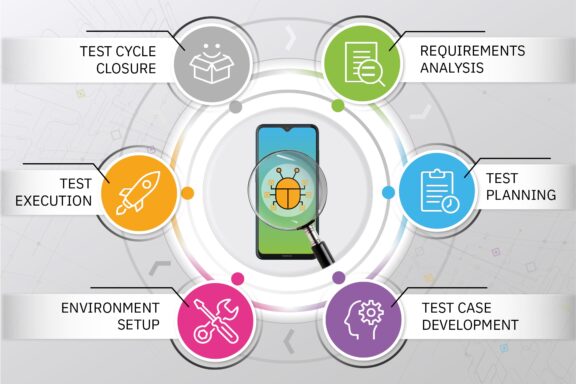
The software program testing life cycle consists of six major phases, every of which entails particular actions designed to make sure that a excessive normal of efficiency and high quality is achieved.
The six major phases of the STLC are:
- Necessities Evaluation
- Check Planning
- Check Case Growth
- Atmosphere Setup
- Check Execution
- Check Cycle Closure
Necessities Evaluation
The necessities evaluation section is the place the QA workforce research the enterprise necessities specification (BRS) doc to establish the necessities from a testing perspective.
This may require the workforce to speak with stakeholders to grasp the necessities in additional element. Alternatively, a mitigation plan will be created if any necessities are usually not testable.
Actions in Necessities Evaluation
- Determine the forms of checks to be carried out and assigned to the event
- Collect particulars about testing priorities and focus
- Put together the Requirement Traceability Matrix (RTM)
- Determine check surroundings particulars the place testing is meant to be carried out
- Conduct automation feasibility evaluation (if wanted)
Deliverables of Necessities Evaluation
- RTM: This doc maps and traces necessities proposed by the consumer with check instances to make sure that each requirement has an related set of check instances towards it.
- Automation feasibility report (if relevant): This report could be produced on account of analysing the mission, understanding what screens have parts that may have automation checks written towards them, the complexity of writing the automation checks, whether or not the check instances deal with massive quantities of check information amongst different elements.
Check Planning
The check planning section is normally carried out by the QA supervisor, it entails creating the check plan and technique paperwork together with figuring out the hassle and price estimates for the whole mission.
Actions in Check Planning
- Preparation of the check plan/technique doc
- Choosing any instruments required throughout the testing
- Check effort estimation
- Coaching requirement
Deliverables of Check Planning
- Check plan doc: The ISTQB defines a check plan as “Check Plan is A doc describing the scope, method, assets, and schedule of meant check actions.”
- Check effort estimation doc: This doc will embrace the estimations of how lengthy it’s going to take to finish the testing duties.
Check Case Growth
The check case growth section entails the creation of check instances for every unit and any check scripts as soon as the check plan is prepared. These check instances cowl the validation, performance and factors of verification described within the Check Plan.
Actions in Check Case Growth
- Making ready the check instances and any automation scripts (if required)
- Enumerating the potential actions of the customers and their goal
- Setting the priorities of check situations
- Choosing the situation beneath which testing will happen
- Documenting any check situations
- Verifying and correcting the check instances primarily based on modifications
Deliverables of Check Case Growth
- Check instances: This can be a set of actions that check a selected piece of performance of the software program mission.
- Check information: The enter is given to a software program program throughout the execution of the check instances.
- Check automation script: These are scripts created by automation engineers with the thought of them being run steadily to scale back the reliance on guide testing.
Check Atmosphere Setup
The check surroundings consists of components that help check execution, the setup of the testing surroundings is completed primarily based on the {hardware} and software program requirement listing. The check surroundings ought to mimic the manufacturing surroundings as intently as potential to uncover any environmental or configuration associated points. This section can go in parallel with the Check Case Growth section.
Actions in Check Atmosphere Setup
- Analysing the necessities and getting ready the listing of required {hardware} and software program to arrange the check surroundings
- Establishing the check surroundings
- Executing a smoke check on the check surroundings to validate the readiness and stability of the check surroundings
Deliverables of Check Atmosphere Setup
- The check surroundings is prepared for the check execution section
- Smoke check outcomes
Check Execution
The check execution section is the execution of check instances which have been created on account of the check case growth section. That is carried out by the testing workforce the place bugs are reported again to the event workforce for them to repair with retesting to be carried out at one other time relying on the software program growth methodology that the mission is following.
Check Execution Actions
- Execution of the check instances
- Recording leads to the businesses check case administration instrument
- Reporting any defects for any failed check instances
- Retesting any defects after these have been mounted by the event workforce
Deliverables of Check Execution
- Report on any defects which have been raised throughout the check execution section
- Total abstract of the check case outcomes
Check Cycle Closure
The check cycle closure section entails the evaluation and analysis of the entire testing cycle to work out what labored and what didn’t.
The QA workforce meets to judge the cycle completion standards primarily based on check protection, high quality, time, value, software program and enterprise targets. The bug and check case stories are analysed to establish the distribution of defects primarily based on severity and kind.
After completion of the check cycle, the check metrics and check closure report might be created.
Check Cycle Closure Actions
- Preparation of the check closure report
- Consider the cycle completion standards (primarily based on check protection, high quality, time, value, software program and enterprise targets)
- Put together check metrics primarily based on the above parameters
Deliverables of Check Cycle Closure
- Check metrics
- Check closure report – a doc that offers a abstract of all of the checks carried out throughout the software program growth life cycle, it additionally provides an in depth evaluation of the bugs eliminated and errors discovered
What are entry and exit standards in STLC?
Entry Standards: Entry standards within the STLC are the stipulations that have to be met earlier than the subsequent section will be began. For some phases of the STLC, the entry standards can generally be the exit standards from a earlier section, akin to check plans, check environments and check instances and check information.Exit Standards: For exit standards, these are normally a set of situations that should be met earlier than the section will be accomplished. It’s essential have entry and exit standards for all phases of the STLC and you shouldn’t enter the subsequent section till all of the exit standards from the earlier section are met.
Desk of STLC Phases with Entry and Exit Standards
Finest Practices within the Software program Testing Life Cycle
A number of finest practices apply to software program testing, one being to undertake the ‘check early check usually’ method. This testing technique helps get the QA workforce concerned as early into the event course of as potential in order that they’ve the prospect to lift any points on the earliest alternative.
This helps to scale back prices because the later into the mission points get discovered the costlier they’re to repair. This finest observe will be present in an iterative growth methodology which is arguably the popular alternative for a lot of IT firms at this time.
One other finest observe within the software program testing life cycle is to undertake the continual testing method, that is the method of executing checks as a part of the supply pipeline to get sooner suggestions on any potential points as quickly as potential.
One other technique is to conduct the precise forms of testing primarily based on the necessities, this could get rid of a lot of redundant checks, growing the time the QA workforce can spend testing the characteristic of the product which ought to cut back the variety of points discovered at a later stage.
One other phrase is the Pesticide Paradox, this comes from the concept that if pesticides are steadily used on crops, there comes a time when the bugs start to develop a sure sort of resistance, making the pesticides ineffective.
This idea will be utilized to testing as properly if the tester runs the identical checks repeatedly, finally, these checks might be ineffective as a result of no extra defects might be discovered.
To resolve this, new check instances must be created at common intervals to assist establish new points. That is one other finest observe to observe when testing software program.
STLC vs. SDLC: What’s the distinction?
The Software program Testing Life Cycle is a section of the Software program Growth Life Cycle, which will be carried out as a part of the Software program Growth Life Cycle or alongside its varied different phases relying on the methodology getting used.
The Software program Testing Life Cycle defines the phases or actions which are carried out to enhance the general high quality of the product.
The Software program Growth Life Cycle (or SDLC) defines all of the phases which are concerned within the full software program growth course of (which incorporates the testing of the product).
The SDLC goals to provide a high-quality software program product that meets the expectations of the consumer, the STLC ensures the product works as it’s anticipated to.
The phases within the SDLC are:
- Necessities Gathering
- Design the software program
- Construct the software program
- Check
- Deployment
Listed here are among the key variations between the SDLC and the STLC:
SDLC
- Father or mother course of
- Focuses on assembly person necessities and growing a helpful product
- All phases have to be accomplished earlier than testing
- Goals to provide customers with a top quality product
STLC
- Baby course of
- Focuses on testing the product to make sure it’s working as meant
- STLC normally begins after the primary growth phases are accomplished
- Goals to search out bugs to report back to the event workforce for fixes
If the SDLC is adopted it ought to make sure that the system necessities are traced again to the enterprise necessities, very like the STLC each section within the SDLC has a selected deliverable, entry and exit standards.
These deliverables are understandably completely different from the deliverables described within the STLC phases, examples are a growth plan is created as a part of the necessities gathering phases within the SDLC whereas within the STLC the QA workforce will create a system check plan.
Defect Life Cycle
The defect life cycle describes the completely different states a bug will be in by its total life, it may also be known as the bug life cycle.
The defect life cycle additionally entails the classification of the completely different priorities and severity of the bugs recognized by the testing workforce.
Defect precedence refers back to the order wherein defects must be resolved (from the QA workforce’s perspective) while defect severity classifies the influence of the defect and the complexity of the repair (from the event workforce’s perspective).
Defect Life Cycle States
- New: The defect has been raised however hasn’t been validated but.
- Assigned: A member of the event workforce has been assigned the defect.
- Lively: The defect is now being investigated by the event workforce.
- Check: The defect has been mounted and is now prepared for the QA workforce to confirm.
- Reopened: The proposed repair has been rejected by the QA workforce so the difficulty stays unresolved.
- Verified: The defect has been mounted and verified by the QA workforce.
- Closed: If the defect now not exists, the state of the bug is mounted and set to ‘closed’.
- Rejected: If the defect has already been raised, not reproducible or not a defect then the bug can enter a ‘rejected’ state
- Deferred: That is when the bug has been prioritised for the subsequent launch.
Defect Priorities
The QA workforce usually units the precedence standing when the defect is dropped at the eye of the event workforce and relies on the top person’s necessities.
Low Precedence: The defect repair is just not of an pressing nature and will be delayed till extra vital fixes are accomplished.
Medium Precedence: The event workforce ought to repair the bug in subsequent builds.
Excessive Precedence: The influence of the bug on the software program is substantial and must be addressed instantly.
Pressing Precedence: The product can’t be used till the defect is mounted so it must be resolved urgently.
Defect Severity
Defect severity relies on how severely the defect impacts the performance of the software program and the way complicated it’s for the event workforce to resolve.
- Important Severity: The defect impacts the core performance of the software program and the QA workforce can not proceed testing the product till it’s mounted. An instance of a defect that’s of crucial severity is one which causes the product to crash usually.
- Main Severity: The defect impacts core features significantly however the check workforce can proceed testing different points of the software program with out this one first having to be mounted.
- Medium Severity: The defect impacts only one display or one particular operate however doesn’t really cease the operate from working.
- Low Severity: The defect has no influence on the product’s performance and is more likely to be purely beauty. Fixes ar4e probably to enhance UX and UI.
Significance of the Software program Testing Life Cycle
Any software program growth mission goals to provide merchandise which are of the very best high quality and the check workforce might help this in some ways.
The primary is adopting the STLC and making certain that every section is outlined at first of the mission – defining the entry and exit standards for every section and making certain the most important stakeholders throughout the mission are conscious of those.
If the necessities are usually not correctly outlined earlier than the top of the necessities gathering section, it will have a detrimental impact on the standard of the product on the finish – as both the QA workforce or growth workforce may very well be lacking key items of data.
If the corporate is utilizing the STLC as a part of the SDLC – the target is to provide a product of the very best high quality, and following these offers the perfect alternative of doing this.
Adopting a number of testing finest practices such because the ‘check early check usually’ method will enormously cut back the variety of points raised at a later stage of the mission, whereas additionally being conscious of the pesticide paradox is crucial for making certain that the standard of check instances stays excessive and the QA workforce time stays efficient.
Need to be taught extra about our method to software program testing?
Right here at Coderus, we method QA and testing with an agile methodology – executing all phases of the QA life cycle course of. We maintain ourselves to the very best trade requirements and endeavour to create a flawless person expertise for all customers, in each mission we work on.









![File Deleter Software program: 6 Greatest We Examined [2023 List]](https://softwahub.com/wp-content/uploads/2023/07/b2b98ac0bf2143a2f708dd680896ee87.jpg)